Last updated: August 24, 2026 | Data verified against official issuer terms and cross-checked with SENAI, Glassdoor, Indeed, and CAGED-based salary portals.
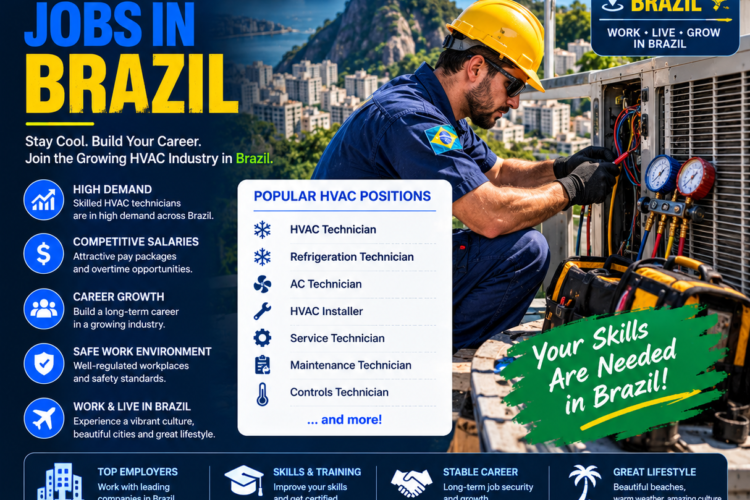
Brazil’s refrigeration, air conditioning, ventilation, and heating (HVAC-R) sector is going through one of its tightest labor markets in years. As data centers multiply, supermarket chains expand cold-storage networks, hospitals modernize climate-controlled wards, and record-breaking heat waves push residential air conditioning adoption to new highs, the country is running short on qualified technicians to install, service, and maintain these systems. For anyone considering a hands-on technical career with steady demand, low barriers to entry, and realistic room for income growth, HVAC technician work in Brazil is worth a serious look.
This guide breaks down what the job actually involves, how much it pays across different regions and experience levels, what certifications and training are required, and how the market is likely to evolve over the next few years.
Why HVAC Demand Is Surging in Brazil
Several forces are converging at once. Brazil’s average temperatures have been trending upward, and unusually intense heat waves in recent years have driven a boom in split air conditioner sales in both new construction and retrofit installations. At the same time, sectors that depend on precise, continuous cooling — supermarkets, pharmaceutical cold chains, hospitals, and industrial facilities — have expanded significantly.
The most visible driver, however, is the explosive growth of data centers in Brazil. These facilities require sophisticated, always-on climate control systems (often precision cooling, chillers, and redundant HVAC infrastructure) and cannot tolerate downtime, which has created a wave of demand for technicians trained in industrial-grade refrigeration and climate systems. Reporting on the sector has noted that <cite index=”15-1″>technicians specializing in commercial refrigeration, critical-area climate control, advanced diagnostics, and preventive maintenance are increasingly in demand, especially at companies operating larger-scale systems</cite>. As older equipment is replaced, the job is also becoming more technical: modern systems now <cite index=”15-1″>incorporate automation, sensors, electronic controls, energy efficiency features, and refrigerant fluids that require proper handling</cite>, which raises the skill floor for entry into the profession.
Meanwhile, industry associations and vocational schools describe a structural shortage of qualified labor — not a lack of job openings, but a lack of trained people to fill them. This imbalance is precisely what has been pushing wages upward for technicians who hold formal certifications, particularly in refrigerant handling and electrical safety.
What the Job Actually Involves
“HVAC technician” in Brazil maps to several related but distinct occupations, each classified under Brazil’s official occupational code system (Classificação Brasileira de Ocupações, or CBO). The most common titles include:
- Técnico em Refrigeração e Climatização (Refrigeration and Air Conditioning Technician) — the broadest and most recognized title, often requiring a formal technical diploma.
- Mecânico de Refrigeração (Refrigeration Mechanic) — a hands-on installation and repair role, frequently entry-level or mid-level.
- Auxiliar Técnico de Refrigeração (Refrigeration Technical Assistant) — an entry point for beginners working under supervision.
- Técnico em Refrigeração Industrial (Industrial Refrigeration Technician) — a specialized, higher-paid track focused on large-scale commercial and industrial systems such as cold rooms, ammonia (NH3) and CO2 systems, and racks.
Across these roles, day-to-day responsibilities typically include installing residential and commercial air conditioning units (split, VRF, and central systems), performing preventive and corrective maintenance, diagnosing electrical and mechanical faults, reading pressure and temperature gauges, identifying refrigerant leaks, filling out technical maintenance reports, and complying with technical, safety, and environmental regulations. Job postings frequently note that experience with VRF systems, a driver’s license, and safety-training certificates are differentiators that help candidates stand out.
How Much HVAC Technicians Earn in Brazil
Salary is where things get nuanced, because the range across sources and experience levels is wide — from close to Brazil’s minimum wage for entry-level, informal, or unlicensed workers up to well above R$5,000/month for certified, experienced technicians in industrial or specialized roles. Below is a synthesis of the most recent salary data available.
National averages
- Indeed’s Brazil salary data puts the national average for “Técnico em Refrigeração” at roughly R$2,806 per month, based on a large sample of self-reported salaries.
- Glassdoor’s aggregated data (covering multiple related job-title variations) shows average annual base pay clustering between roughly R$2,700 and R$3,050, translating to a typical monthly range in the low-to-mid R$2,000s, with a 90th-percentile ceiling that can exceed R$10,000 annually for the highest-reported salaries in that dataset.
- A 2026 industry report citing CAGED-based labor data (Portal Salário) put the average salary floor (“piso salarial”) at approximately R$3,448 in 2026, while separately noting that CLT-registered refrigeration technicians can earn upward of R$4,400 per month, particularly in specialized commercial and industrial roles.
- Industry coverage of the sector’s labor shortage similarly points to entry-level positions starting between roughly R$2,500 and R$5,500 per month, depending on qualification level, specialization (installation, maintenance, or industrial refrigeration), and location, with independent installers often earning more than CLT-registered employees, especially during peak summer demand for air conditioning installs.
- A related but distinct role, Técnico em Refrigeração Industrial, commands a noticeably higher average, with one salary-aggregation source estimating pay in the range of R$3,300–R$3,400 per month nationally for that more specialized title.
Regional variation
Pay varies meaningfully by state and city. Indeed’s location-specific data shows:
- São Paulo, SP: average around R$3,174/month — one of the higher-paying metro areas, reflecting the concentration of industrial, commercial, and data-center demand in the state.
- Rio de Janeiro, RJ: average around R$2,626/month.
- Fortaleza, CE: average around R$2,307/month, illustrating the lower cost-of-living, lower-wage pattern typical of the Northeast region.
- Salvador, BA: average estimated around R$2,950/month on Glassdoor’s aggregated data.
Separately, aggregated job-market data lists Criciúma (SC), São Paulo (SP), and São José (SC) among the metro areas with the strongest pay for refrigeration technicians, reflecting the concentration of manufacturing, cold-chain logistics, and industrial cooling infrastructure in the South and Southeast regions.
Key takeaway on pay
Formal qualifications matter enormously. Workers without a recognized technical certificate or safety-training credentials tend to cluster near the lower end of the range (roughly R$2,000–R$2,900/month), while technicians with a SENAI technical diploma, refrigerant-handling training, and NR-10/NR-35 safety certifications routinely report salaries in the R$3,500–R$5,500+ range, and specialists in industrial refrigeration, data-center cooling, or large commercial systems can exceed that. Independent contractors and freelance installers also frequently out-earn CLT-registered employees during high-demand periods, though without the same benefits and job security.
Certifications and Training Required
Unlike some technical trades, HVAC work in Brazil doesn’t require a single national license to practice — but formal training dramatically improves both hiring prospects and pay, and certain safety certifications are effectively mandatory for specific tasks.
1. Technical education through SENAI
The Serviço Nacional de Aprendizagem Industrial (SENAI) is the primary and most widely recognized training provider for HVAC careers in Brazil, with units in every state. SENAI offers multiple tiers:
- Short qualification courses (“Qualificação Profissional”), often 160–180 hours, aimed at people entering the field quickly as helpers or entry-level installers.
- Full technical diploma programs (“Habilitação Técnica de Nível Médio”), which run roughly 1,200 hours and require either completed or concurrent high-school enrollment. These programs cover <cite index=”21-1″>fundamentals of mechanics, electricity, and refrigeration; installation of split, VRF, chiller, cold-room, rack, ammonia, and CO2 systems; evacuation techniques, refrigerant charging, brazing, and wiring; preventive and corrective maintenance; use of instruments like manifold gauges, multimeters, thermometers, and anemometers; and project design including thermal load calculations</cite>. Programs also typically cover <cite index=”21-1″>maintenance planning and control (PMOC) and environmental regulations related to refrigerants</cite>.
- Industrial refrigeration specialization tracks, which reference specific Brazilian technical standards such as <cite index=”28-1″>ABNT NBR 15960 (refrigerant fluid recovery, recycling, and regeneration procedures) and the NBR 16401 series governing air-conditioning system design and thermal comfort parameters</cite>.
2. Mandatory safety certifications (NRs)
Brazil’s Ministry of Labor enforces occupational safety standards called Normas Regulamentadoras (NRs), and two are essential for HVAC technicians:
- NR-10, covering electrical safety, is required for any technician working on systems with voltage above 50V AC — which covers virtually all residential and commercial HVAC electrical work.
- NR-35, covering work at height, is required for installing split units on upper floors, rooftop central systems, or building façades — an extremely common part of the job.
SENAI and other technical schools offer both certifications, typically ranging from 8 to 40 hours depending on the training level. Employers increasingly require proof of both before hiring, and in many cases the liability for non-compliance now extends to the contracting company, not just the individual technician — a shift that has made certified candidates significantly more competitive.
3. Refrigerant handling and environmental compliance
Brazil’s environmental regulations around refrigerant gases — tied to the country’s commitments under the Montreal Protocol and domestic “Lei do Ozônio” framework — increasingly require documented training in responsible handling, recovery, and disposal of refrigerant fluids. This is both a legal requirement and a practical skill, since improper refrigerant handling can result in environmental fines for the employer.
4. Pathway summary for newcomers
For someone starting from zero, the typical progression looks like:
- Complete a short SENAI qualification course (a few months) to become an auxiliar or ajudante de refrigeração.
- Gain hands-on field experience while pursuing NR-10 and NR-35 certification.
- Enroll in a full technical diploma program to become a certified Técnico em Refrigeração e Climatização, typically requiring a completed high-school education.
- Specialize — through additional coursework or on-the-job training — in higher-paying niches such as industrial refrigeration, VRF systems, chillers, or data-center precision cooling.
Where the Jobs Are
Job volume is heavily concentrated in São Paulo state, both because of its industrial base and because it hosts the largest concentration of commercial and data-center construction in the country. Job-search platforms consistently list São Paulo as the city with the highest number of open positions and new hires for refrigeration and climate-control roles.
Beyond São Paulo, strong demand also exists in:
- Southern Brazil (Santa Catarina, Rio Grande do Sul, Paraná) — driven by manufacturing, food processing, and cold-chain logistics.
- Rio de Janeiro — commercial buildings, hospitality, and healthcare facilities.
- Northeastern capitals (Fortaleza, Salvador, Recife) — growing residential air conditioning demand tied to climate and urbanization, though wages tend to run lower than the Southeast.
- Minas Gerais — industrial and logistics hubs, including strong demand in cities like Contagem.
Job boards such as Catho and Indeed regularly list hundreds to tens of thousands of open postings nationally at any given time (aggregator sites report figures ranging from a few hundred specialized industrial openings to tens of thousands of broader refrigeration and climate-control listings), reflecting both the breadth of the category and the ongoing shortage of qualified applicants.
Who Hires HVAC Technicians in Brazil
Employers span a wide range of sectors:
- HVAC installation and maintenance contractors — the most common employer type, ranging from small local businesses to large national service companies.
- Equipment manufacturers and their authorized service networks (e.g., major air conditioning and refrigeration brands operating in Brazil), which often provide structured training and career paths.
- Supermarket and retail chains, which employ in-house or contracted technicians to maintain refrigerated display cases and cold-storage rooms.
- Hospitals and healthcare facilities, where climate control is mission-critical for patient safety and equipment (including vaccine and medication cold storage).
- Data centers and telecom infrastructure companies, an increasingly significant and higher-paying employer category.
- Industrial facilities and food processing plants, which rely on refrigeration for production and storage.
- Facilities management and building maintenance firms, which bundle HVAC service into broader building-operations contracts.
- Self-employment/independent contracting, common among experienced technicians, particularly for residential installation work, which sees strong seasonal demand during Brazil’s hottest months.
Career Progression and Specialization
Entry-level workers typically start as auxiliares or ajudantes, assisting certified technicians with installation and basic maintenance while completing training. With experience and certification, they move into full técnico roles, and from there can specialize into:
- Industrial and commercial refrigeration (cold rooms, supermarket racks, ammonia/CO2 systems) — generally the highest-paying track outside of niche data-center work.
- VRF and central chiller systems for large commercial buildings.
- Data center precision cooling, an emerging and well-compensated specialty tied to Brazil’s growing digital infrastructure sector.
- Project design and technical supervision, for technicians who pursue further education (e.g., an engineering technologist degree) and move into roles specifying and overseeing HVAC system design rather than hands-on installation.
- Business ownership, since many experienced technicians eventually start their own installation and maintenance companies, particularly in residential and small-commercial markets.
Challenges in the Profession
The job isn’t without difficulties. Reporting on the sector highlights a structural shortage of qualified labor as the central challenge — one significant enough to affect operational continuity in supermarkets, hospitals, industrial plants, and data centers when systems fail and no certified technician is available nearby. For workers, this translates into strong bargaining power but also pressure: technicians are often expected to master an expanding set of skills as systems become more automated, sensor-driven, and energy-efficiency-regulated.
Physical demands are also real — the work often involves confined spaces, rooftops, ladders, and exposure to pressurized refrigerant systems, which is precisely why NR-10 and NR-35 certification exists. Informal, uncertified work remains common in the lower end of the market, which depresses wages for workers without documentation, even though demand for certified technicians specifically continues to outstrip supply.
Outlook for the Rest of the Decade
Several structural trends point toward continued strong demand for certified HVAC technicians in Brazil through the late 2020s:
- Data center expansion shows no signs of slowing, and each new facility requires ongoing, specialized maintenance staff, not just installation crews.
- Climate trends are likely to keep driving residential and commercial air conditioning adoption higher, particularly in regions that historically had lower penetration.
- Regulatory tightening around refrigerants and energy efficiency is likely to keep raising the skill (and certification) bar, which should continue to favor formally trained technicians over informal labor.
- Retrofit and modernization cycles — replacing older, less efficient systems — will sustain demand independent of new construction.
Frequently Asked Questions
Do I need a college degree to become an HVAC technician in Brazil? No. Most technicians enter through SENAI’s technical-level programs, which require a completed (or in-progress) high school education, not a university degree. Short qualification courses can get beginners into entry-level roles even faster, though a full technical diploma leads to better pay and more job security.
Is NR-10 or NR-35 certification legally required? For specific tasks, yes. NR-10 is required for electrical work above 50V, which covers nearly all HVAC electrical connections, and NR-35 is required for any work at height, including most split-unit installations. Reputable employers increasingly refuse to hire or assign work to technicians without these certificates.
What’s the realistic starting salary? Based on current aggregated data, entry-level and less-certified positions generally start in the R$2,000–R$2,900/month range, while certified technicians with a technical diploma and safety training typically earn R$3,000–R$4,500/month, with experienced specialists in industrial or data-center refrigeration earning more.
Which region pays the most? São Paulo state consistently shows the highest average pay and the largest volume of job openings, followed by industrial hubs in Santa Catarina and Minas Gerais. The Northeast generally offers lower average wages, consistent with regional cost-of-living differences.
Is this a growing field? Yes. Multiple independent data sources — job boards, salary aggregators, and industry press coverage — point in the same direction: rising demand driven by data centers, cold-chain retail, healthcare, and residential air conditioning, combined with a persistent shortage of certified technicians.
Can I work independently instead of for a company? Yes, and many experienced technicians do, particularly for residential installation and maintenance. Independent contractors can earn more than CLT-registered employees during peak demand periods, though without the benefits, protections, or steady salary that formal employment provides.
Sources
- Indeed Brasil — Técnico em Refrigeração salary data (national)
- Indeed Brasil — Técnico em Refrigeração salary, São Paulo, SP
- Indeed Brasil — Técnico em Refrigeração salary, Rio de Janeiro, RJ
- Indeed Brasil — Técnico em Refrigeração salary, Fortaleza, CE
- Glassdoor Brasil — Técnico em Refrigeração e Climatização salary data
- Glassdoor Brasil — Técnico de Refrigeração, Salvador, BA salary data
- Portal Salário — Mecânico de Refrigeração salary and labor-market data (CBO 725705)
- Portal Salário — Técnico de Refrigeração (instalação) salary and hiring-trend data
- Portal Salário — Auxiliar Técnico de Refrigeração salary and hiring-trend data (CBO 314115)
- Click Petróleo e Gás — “Técnicos de refrigeração viram peça rara no Brasil” — labor shortage report
- SENAI-RS — Técnico em Refrigeração e Climatização course curriculum
- SENAI-PE — Mecânico de Refrigeração e Climatização Industrial course, ABNT standards referenced
- Catho — Técnico em Refrigeração Industrial job listings
- Indeed Brasil — Técnico Refrigeração e Climatização job listings
- Jooble Brasil — Técnico em refrigeração industrial salary aggregation
Editorial note: Salary figures in this article are drawn from third-party job boards and salary-aggregation platforms (Indeed, Glassdoor, Jooble, Portal Salário/CAGED-based estimates), which rely on self-reported data and job-posting analysis rather than an official government wage census. Figures should be treated as directional estimates, not guaranteed pay rates, and can vary by employer, contract type (CLT vs. independent/PJ), and regional cost of living. This article will be periodically reviewed and updated as new salary and labor-market data becomes available.