Last updated: August 22, 2026 | Data verified against official issuer terms (German Federal Ministry of the Interior / Make it in Germany portal) and multiple independent salary sources
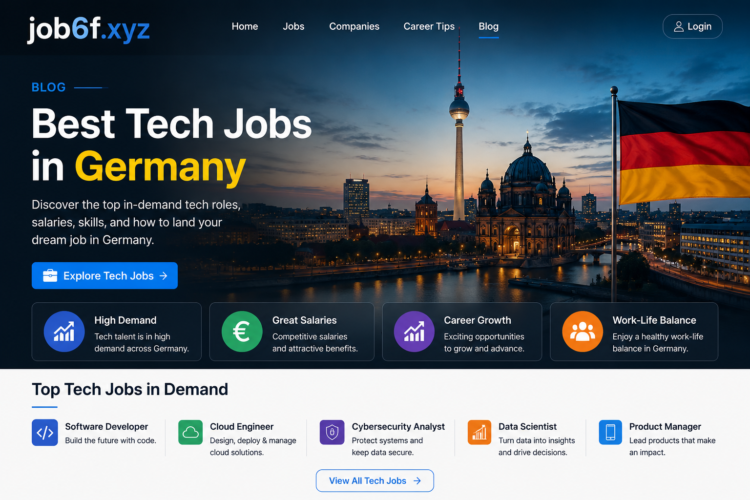
Germany has quietly become one of the most reliable places in the world to build a technology career. It isn’t the flashiest tech scene — that title still tends to go to the US or parts of Asia — but it may be the most stable one. A shrinking domestic workforce, an aggressive digitalisation push across manufacturing and finance, and one of the most accessible skilled-worker visa systems in Europe have combined to create sustained, structural demand for tech talent that shows no sign of easing.
This guide walks through the roles currently paying the most, the cities where those salaries go furthest, the visa routes that make Germany realistic for non-EU applicants, and the practical steps to actually land a job there.
Why Germany’s Tech Sector Is Booming Right Now
Three forces are driving the current hiring wave.
An ageing workforce meets a digital economy. Germany’s industrial base — automotive, manufacturing, logistics, finance — is digitising faster than it can hire, while a wave of retirements is thinning the existing talent pool. Industry associations have tracked well over 100,000 unfilled IT positions in the country through 2026, a figure that has grown substantially over the past several years.
Software-defined everything. The German auto industry’s shift toward electric and software-defined vehicles has turned Munich and Stuttgart into unlikely software hubs, with BMW, Volkswagen, Bosch, and Siemens all competing for backend, embedded, and AI engineering talent alongside traditional tech employers.
A startup and fintech scene with real staying power. Berlin remains the country’s startup capital, home to companies like Zalando, N26, Trade Republic, and HelloFresh, and it operates almost entirely in English — a meaningful detail for internationally mobile candidates.
The result is a labour market where qualified tech professionals — local or foreign — are negotiating from a position of strength.
The Highest-Paying Tech Roles in Germany in 2026
Salary figures below represent typical gross annual ranges for professionals with several years of experience, drawn from multiple German salary-benchmarking sources. Actual pay varies by city, company size, and seniority, and gross salary is not take-home pay — expect roughly 30–40% to go toward taxes and mandatory social contributions.
1. Machine Learning / AI Engineer — €95,000–€130,000+
AI pay has decoupled from “normal” software salaries over the past two years. Machine learning engineers with production experience — not just research backgrounds — are commanding premiums that put them well above the general software-engineering band, particularly in Munich and Berlin. MLOps and applied-science roles at the senior level frequently move into six figures.
2. Software Architect — €90,000–€130,000
Architects who can design and steward complex systems across a team’s lifecycle remain scarce and well compensated, especially at companies mid-way through a legacy-to-cloud migration.
3. Cybersecurity Engineer / Specialist — €80,000–€120,000
Regulatory pressure is doing a lot of the hiring here. The EU’s NIS2 directive and ongoing GDPR enforcement have pushed cybersecurity from a “nice to have” into a compliance requirement for mid-sized and large employers alike, and the talent supply hasn’t caught up.
4. DevOps / Platform Engineer — €70,000–€105,000
DevOps engineers fluent in Kubernetes, Terraform, and either AWS or Azure are consistently near the top of demand lists. Architect-level DevOps and platform roles can exceed €100,000.
5. Data Scientist — €60,000–€95,000
The 2018–2021 “gold rush” salary spikes for data science have normalised, but demand is still strong, particularly for specialists who pair statistical skills with a specific industry domain — fintech risk modelling or Industry 4.0 predictive maintenance, for example, rather than generalist data science.
6. Cloud Engineer / Architect — €70,000–€110,000
Germany’s regulatory environment has pushed many companies toward “sovereign cloud” solutions that keep data within EU jurisdiction, adding a specialised layer of demand on top of standard AWS/Azure/GCP cloud engineering.
7. Backend Engineer (Java / Go) — €60,000–€95,000
Backend roles remain the steady backbone of the market. Notably, the programming language affects pay: Java and Go developers tend to out-earn Python backend developers of similar seniority, largely because the Python talent pool is deeper. Rust is an emerging niche with strong pay but limited openings.
8. Full-Stack Developer — €55,000–€90,000
Full-stack developers who can move between React/Angular frontends and a Java, Python, or Node backend remain broadly employable across startups and enterprise alike, even if they don’t top the highest-paid list.
9. IT Project Manager (Agile/Scrum) — €70,000–€90,000+
Technical project managers with genuine agile delivery experience are in high demand, particularly on international teams where coordinating distributed engineering groups is a distinct skill from the technical work itself.
10. SAP Consultant (S/4HANA, ABAP) — €65,000–€100,000
A quieter but very durable source of demand: thousands of German mid-sized companies (the Mittelstand) still run on SAP, and the migration to S/4HANA has created a multi-year wave of consulting and in-house SAP work.
| Role | Typical Gross Salary Range (EUR/year) | Key Hubs |
|---|---|---|
| ML / AI Engineer | €95,000 – €130,000+ | Munich, Berlin |
| Software Architect | €90,000 – €130,000 | Munich, Frankfurt |
| Cybersecurity Engineer | €80,000 – €120,000 | Frankfurt, Munich |
| DevOps / Platform Engineer | €70,000 – €105,000 | Berlin, Munich |
| Cloud Engineer/Architect | €70,000 – €110,000 | Frankfurt, Munich |
| IT Project Manager | €70,000 – €90,000+ | Frankfurt, Berlin |
| SAP Consultant | €65,000 – €100,000 | Walldorf, Frankfurt, Munich |
| Data Scientist | €60,000 – €95,000 | Berlin, Munich |
| Backend Engineer (Java/Go) | €60,000 – €95,000 | Nationwide |
| Full-Stack Developer | €55,000 – €90,000 | Berlin, Hamburg |
For general (non-specialised) IT roles across all levels, market data puts the average salary in Germany at roughly €51,800–€54,200 in 2026, with a typical range of €30,000–€76,000 depending on experience and location.
Best Cities for Tech Jobs in Germany
Where you work matters almost as much as what you do — both for salary and for cost of living.
- Munich — Generally the highest-paying city for tech, thanks to the concentration of automotive, deep-tech, and large engineering employers (BMW, Siemens, and a dense cluster of AI and semiconductor firms). Also one of the most expensive cities to live in.
- Berlin — The startup and English-language-friendly capital. Base salaries typically run somewhat below Munich, but many startups offset that with equity (ESOP) packages, and the cost of living, while rising, remains more manageable.
- Frankfurt — Germany’s financial centre, and consequently the best market for fintech, cybersecurity, and regulated-industry tech roles.
- Hamburg — Strong for e-commerce and logistics tech, with a lower cost of living than Munich or Frankfurt.
- Stuttgart — Automotive-software territory, closely tied to Mercedes-Benz, Porsche, and Bosch.
- Cologne — A solid, more affordable alternative with a growing tech scene and decent pay relative to living costs.
In-Demand Skills Employers Are Actually Hiring For
Across job postings and salary surveys, a fairly consistent skills picture emerges for 2026:
- AI and machine learning — particularly production ML, LLM integration, and applied AI rather than pure research
- Cloud platforms — AWS, Azure, and Google Cloud, with growing demand for “sovereign cloud” and hybrid architectures
- Cybersecurity — driven heavily by NIS2 compliance deadlines
- DevOps tooling — Kubernetes, Terraform, CI/CD pipelines
- Data engineering — the less glamorous but consistently in-demand cousin of data science
- SAP S/4HANA — a durable, Germany-specific niche
- Backend languages — Java, Go, and Python remain the most requested; JavaScript/TypeScript dominates frontend, alongside React and Angular
German language skills are not a strict requirement for most tech roles, especially in Berlin, Munich, and Frankfurt, where many companies — particularly startups — operate in English day to day. That said, German ability (even conversational B1/B2 level) meaningfully widens your options, especially outside the largest cities and for roles involving client-facing or cross-functional work with non-technical German colleagues.
Visa Routes for Non-EU Tech Professionals
This is the section international candidates care about most, so it’s worth getting precise. Germany updates its skilled-worker visa salary thresholds every January, and the 2026 figures represent roughly a 5% increase over 2025.
EU Blue Card
The EU Blue Card is the flagship route for qualified non-EU professionals with a job offer in hand, issued under Section 18g of the German Residence Act.
- Standard threshold (2026): €50,700 gross per year (about €4,225/month)
- Reduced threshold for shortage occupations, IT specialists, and recent graduates (2026): €45,934.20 gross per year (about €3,827/month)
IT is officially classified as a shortage occupation, so most software engineering, data, cloud, DevOps, and cybersecurity roles qualify at the lower threshold. Notably, IT specialists can qualify for the EU Blue Card without a university degree if they can demonstrate at least three years of relevant professional experience within the last seven years — a rule specifically designed to recognise self-taught and bootcamp-trained developers.
A few practical notes worth knowing before you negotiate an offer:
- The threshold only counts guaranteed, fixed gross base salary — performance bonuses, commissions, stock options, and sign-on bonuses do not count toward it.
- At the shortage-occupation threshold, the Federal Employment Agency (Bundesagentur für Arbeit) must approve the employment, which can add some processing time; above the standard threshold, this approval isn’t required.
- The Blue Card is one of the fastest routes to permanent residency in Germany: as little as 21 months with German at B1 level, or around 27–33 months without.
Opportunity Card (Chancenkarte)
If you don’t yet have a job offer, the Opportunity Card is a points-based visa that lets you enter Germany to search for work and take on trial employment while you look. It’s a reasonable option if you’re confident in your skills but want to interview locally and build a network before committing — though it does mean managing a job search on a clock, so financial reserves and realistic timelines matter.
Skilled Worker Visa
A more general route for those with recognised qualifications who may not meet Blue Card salary thresholds or whose employer or role doesn’t fit the Blue Card criteria neatly.
Important caveat: Visa rules, salary thresholds, and shortage-occupation lists change annually and are set by the German Federal Ministry of the Interior. The figures above are accurate as of this update but should always be verified against the official government source before you rely on them for an application — see the sources list below.
How to Actually Land a Tech Job in Germany
- Get your CV into German-market shape. German employers generally expect a concise, fact-driven CV (a “Lebenslauf”) — one to two pages, chronological, with dates in month/year format and no unexplained employment gaps. A professional photo is optional and increasingly uncommon for tech roles, but not unusual.
- Use the right job boards. Beyond LinkedIn, German-specific platforms like StepStone, Xing, and Indeed’s German listings surface roles that don’t always get cross-posted internationally.
- Target companies that already sponsor visas. Larger multinationals (SAP, Siemens, Bosch, Deutsche Telekom) and well-funded startups (Zalando, N26, Trade Republic, HelloFresh, SoundCloud) have established sponsorship processes and are generally lower-friction than smaller companies hiring internationally for the first time.
- Negotiate the base salary, not just total comp — especially if you need the Blue Card. Because only fixed base salary counts toward the visa threshold, make sure any offer near the cutoff has enough guaranteed base pay, not bonus-heavy structure, to actually qualify.
- Consider a recognised credential check early. If you have a non-German university degree, checking its recognition status via the ANABIN database (or requesting a Statement of Comparability from the Central Office for Foreign Education, ZAB) before you apply for jobs can save weeks of delay later in the visa process.
- Learn at least conversational German if you’re staying long-term. It isn’t required for most tech jobs in Berlin, Munich, or Frankfurt, but it noticeably expands your options outside the big three cities and helps with day-to-day life, banking, housing contracts, and integration generally.
Frequently Asked Questions
Do I need to speak German to get a tech job in Germany? Not usually, especially in Berlin, Munich, and Frankfurt, where many tech employers — particularly startups — operate primarily in English. German skills help outside the largest hubs and for more senior or client-facing roles.
What’s the minimum salary for an EU Blue Card in IT? For 2026, IT roles generally qualify at the reduced shortage-occupation threshold of €45,934.20 gross per year, rather than the general €50,700 threshold, because IT is officially recognised as a shortage occupation.
Can I get an EU Blue Card without a university degree? Yes, specifically for IT roles. If you can demonstrate at least three years of relevant professional IT experience within the last seven years, you can qualify for the Blue Card via the “IT specialist” pathway even without a formal degree.
Which German city pays tech workers the most? Munich generally leads on raw salary, largely due to the concentration of automotive and deep-tech employers, though Frankfurt is competitive for fintech and cybersecurity roles, and Berlin startups often make up lower base pay with equity.
How much of my gross salary will I actually take home? Expect deductions of roughly 30–40% for taxes, health insurance, pension, and unemployment insurance contributions — so a €100,000 gross salary typically nets somewhere around €58,000–€62,000, depending on your tax class and city.
Final Take
Germany’s tech labour market in 2026 is unusual in a good way: strong, structural demand meets an immigration system that has been deliberately redesigned over the past few years to make it easier — not harder — for qualified professionals to move there. If your skills sit in AI, cloud, cybersecurity, or DevOps, and you meet the Blue Card’s shortage-occupation threshold, Germany is currently one of the more realistic and rewarding destinations in the world for a tech career move.
That said, immigration rules and salary thresholds change annually. Treat the figures in this guide as a strong starting point for research, not a final answer — and verify anything visa-related directly against the official government source before making decisions.
Reliable Sources
- Make it in Germany — official government portal for skilled immigration (Federal Ministry for Economic Affairs and Energy)
- German Federal Employment Agency (Bundesagentur für Arbeit)
- Federal Ministry of the Interior and Homeland (BMI) — EU Blue Card threshold announcements
- BITKOM — German Digital Association, IT vacancy and labour market reporting
- ANABIN database — foreign degree recognition
- StepStone Germany — salary and job market data
- Indeed Hiring Lab — Germany labour market trend data
Disclaimer: This article is for general informational purposes only and does not constitute immigration, legal, or financial advice. Salary figures are approximate market estimates drawn from multiple third-party sources and will vary by employer, experience, and negotiation. Visa salary thresholds and shortage-occupation lists are set and updated annually by the German government — always confirm current requirements on the official Make it in Germany portal or with a qualified immigration adviser before making decisions based on this guide.